

When it comes to optimizing logistics and warehousing operations, plastic pallets have emerged as a popular choice due to their durability, hygiene, and versatility. As a plastic pallet supplier, I understand the importance of making informed decisions when it comes to selecting the right pallets for your business. One crucial factor to consider is the cost - effectiveness of plastic pallets. In this blog post, I will guide you through the process of calculating the cost - effectiveness of plastic pallets, helping you make a more informed purchasing decision.
Understanding the Components of Cost - Effectiveness
Cost - effectiveness is not just about the upfront purchase price. It encompasses a range of factors over the entire lifecycle of the plastic pallets. These factors include the initial purchase cost, maintenance costs, replacement frequency, and the impact on operational efficiency.
Initial Purchase Cost
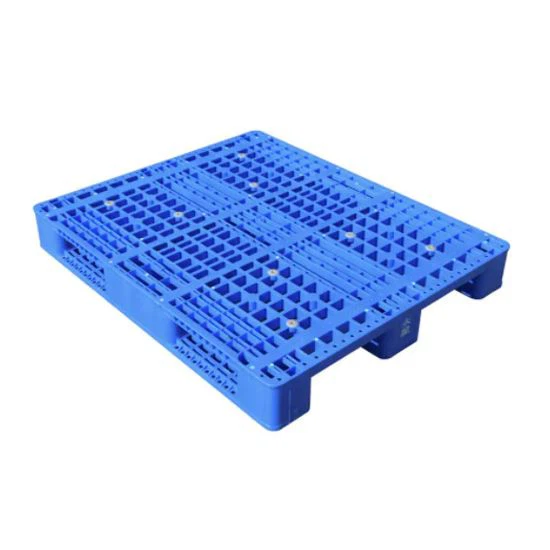
The first step in calculating cost - effectiveness is to determine the initial purchase price of the plastic pallets. Different types of plastic pallets come with varying price tags. For example, our Warehouse Four Way Plastic Pallet is designed for easy handling from all four sides, which may have a different price compared to a standard two - way entry pallet. The material used, such as high - density polyethylene (HDPE), also affects the price. Our Warehouse Four Way HDPE Plastic Pallet offers enhanced durability but may come at a slightly higher initial cost.
When comparing the initial purchase cost, it's essential to consider the quantity you need. Bulk purchasing often leads to volume discounts, which can significantly reduce the per - unit cost. However, you should also be cautious not to over - purchase, as storing excess pallets can incur additional costs.

Maintenance Costs
Unlike wooden pallets, plastic pallets generally require less maintenance. They are resistant to moisture, pests, and chemicals, which means they are less likely to rot, warp, or be damaged by insects. This reduces the need for regular inspections, repairs, and treatments.
However, there may still be some maintenance costs associated with plastic pallets. For example, if a pallet gets damaged during use, you may need to replace certain parts or the entire pallet. But these costs are usually much lower compared to wooden pallets. To estimate maintenance costs, you can look at historical data if you have used plastic pallets before. If not, you can consult with your plastic pallet supplier for an estimate based on typical usage scenarios.
Replacement Frequency
The lifespan of plastic pallets is another critical factor in calculating cost - effectiveness. High - quality plastic pallets can last for several years, depending on the intensity of use and the environment in which they are used. For example, pallets used in a high - volume distribution center may experience more wear and tear compared to those used in a low - volume warehouse.
To estimate the replacement frequency, you need to consider the expected number of trips or cycles the pallets will undergo. A well - made plastic pallet can withstand thousands of trips before it needs to be replaced. By dividing the initial purchase cost by the expected number of trips or the estimated lifespan of the pallet, you can get an idea of the cost per use.
Operational Efficiency
Plastic pallets can have a significant impact on operational efficiency, which in turn affects cost - effectiveness. Their uniform size and shape make them easier to stack, store, and handle with automated equipment. This can lead to faster loading and unloading times, reduced labor costs, and improved warehouse space utilization.
For example, our Warehouse Racking Plastic Pallet is specifically designed for use with racking systems. Its design ensures proper weight distribution and stability, which can prevent accidents and damage to goods. By improving operational efficiency, plastic pallets can indirectly save your business money in the long run.
Calculating the Cost - Effectiveness
Now that we understand the components of cost - effectiveness, let's look at how to calculate it. The following is a step - by - step guide:
Step 1: Determine the Initial Investment
Calculate the total cost of purchasing the plastic pallets, including any shipping and handling fees. If you are getting a volume discount, make sure to factor that in.
Step 2: Estimate Maintenance and Replacement Costs
Based on historical data or supplier estimates, calculate the total maintenance and replacement costs over the expected lifespan of the pallets. Divide this total by the number of years or the expected number of trips to get an annual or per - use cost.
Step 3: Quantify Operational Savings
Estimate the savings in labor costs, loading and unloading times, and warehouse space utilization due to the use of plastic pallets. This can be a bit more challenging as it requires detailed analysis of your current operations. You may need to work with your logistics and warehouse management teams to gather this data.
Step 4: Calculate the Total Cost - Effectiveness
Subtract the operational savings from the sum of the initial investment, maintenance, and replacement costs. Then divide this result by the expected number of trips or the estimated lifespan of the pallets. The lower the cost per use, the more cost - effective the plastic pallets are.
Here is a simple formula to summarize the calculation:
[
\text{Cost - effectiveness per use}=\frac{\text{Initial Investment}+\text{Total Maintenance and Replacement Costs}-\text{Operational Savings}}{\text{Expected Number of Trips or Lifespan}}
]
Case Study
Let's consider a case study to illustrate how to calculate the cost - effectiveness of plastic pallets. A medium - sized distribution center is considering replacing its wooden pallets with plastic pallets.
- Initial Investment: The distribution center needs 1000 plastic pallets. The cost per pallet is $50, so the total initial investment is $50,000.
- Maintenance and Replacement Costs: Based on the supplier's estimate, the maintenance and replacement costs over a five - year period are expected to be $5,000.
- Operational Savings: By using plastic pallets, the distribution center expects to save $10,000 per year in labor costs and $5,000 per year in warehouse space utilization. So the total operational savings over five years are ($10,000 + $5,000)×5 = $75,000.
- Expected Number of Trips: The pallets are expected to make 10,000 trips over the five - year period.
Using the formula above:
[
\begin{align*}
\text{Cost - effectiveness per use}&=\frac{50000 + 5000-75000}{10000}\
&=\frac{55000 - 75000}{10000}\
&=\frac{- 20000}{10000}\
&=- 2
\end{align*}
]
In this case, the negative value indicates that the plastic pallets are actually generating a net savings per use. This shows that in the long run, plastic pallets can be a very cost - effective option.
Conclusion
Calculating the cost - effectiveness of plastic pallets requires a comprehensive analysis of multiple factors, including the initial purchase cost, maintenance costs, replacement frequency, and operational efficiency. By taking the time to perform this analysis, you can make a more informed decision that will benefit your business in the long run.
As a plastic pallet supplier, I am here to help you navigate this process. Whether you need more information about our Warehouse Four Way Plastic Pallet, Warehouse Racking Plastic Pallet, or Warehouse Four Way HDPE Plastic Pallet, or you want to discuss your specific requirements, please feel free to reach out. We can work together to find the most cost - effective plastic pallet solution for your business.
References
- "Plastic Pallets: A Comprehensive Guide", Industry Report, Logistics Research Institute
- "Cost - Benefit Analysis of Plastic vs. Wooden Pallets", Journal of Supply Chain Management


