

As a supplier of galvanized steel pallets, I often encounter technical questions from customers. One question that has come up more frequently lately is about the Poisson's ratio of galvanized steel pallets. In this blog post, I'll dive deep into what the Poisson's ratio is, its significance for galvanized steel pallets, and how it impacts the performance of these essential industrial tools.
Understanding Poisson's Ratio
Before we discuss the Poisson's ratio of galvanized steel pallets, let's first understand what Poisson's ratio is. Poisson's ratio, denoted by the Greek letter ν (nu), is a measure of the ratio of transverse strain to axial strain in a material when it is subjected to an axial load. In simpler terms, when you pull or compress a material in one direction, it will not only deform in that direction but also in the perpendicular directions. Poisson's ratio quantifies this lateral deformation relative to the longitudinal deformation.
Mathematically, Poisson's ratio is defined as:
ν = -ε_transverse / ε_axial
Where ε_transverse is the transverse strain (the strain in the direction perpendicular to the applied load) and ε_axial is the axial strain (the strain in the direction of the applied load). The negative sign is included to make the ratio positive because transverse strain is usually in the opposite sense to axial strain (when a material is stretched axially, it contracts transversely).
The value of Poisson's ratio ranges from -1 to 0.5 for most engineering materials. For isotropic materials (materials with the same properties in all directions), the theoretical upper limit is 0.5, which represents an incompressible material. In practice, most metals have Poisson's ratios between 0.25 and 0.35.
Poisson's Ratio of Galvanized Steel
Galvanized steel is steel that has been coated with a layer of zinc to protect it from corrosion. The base material of galvanized steel is typically carbon steel, and the Poisson's ratio of carbon steel is well - established in the engineering literature. The Poisson's ratio of carbon steel is approximately 0.28 - 0.30.
The galvanization process, which involves coating the steel with zinc, does not significantly change the Poisson's ratio of the underlying steel. This is because the zinc coating is relatively thin compared to the thickness of the steel substrate, and its mechanical properties have a negligible effect on the overall deformation behavior of the galvanized steel. So, for all practical purposes, we can assume that the Poisson's ratio of galvanized steel pallets is in the range of 0.28 - 0.30, similar to that of carbon steel.
Significance of Poisson's Ratio for Galvanized Steel Pallets
The Poisson's ratio of galvanized steel pallets has several important implications for their design, performance, and use:
Structural Design
In the design of galvanized steel pallets, engineers need to consider the Poisson's ratio when calculating the stresses and strains in the pallet structure. For example, when a pallet is loaded with heavy goods, the axial compression or tension in the pallet's beams and supports will cause transverse deformation. If the Poisson's ratio is not taken into account, the calculated stresses may be inaccurate, leading to a potentially unsafe or inefficient design.
Load - Bearing Capacity
The Poisson's ratio affects the load - bearing capacity of galvanized steel pallets. When a pallet is loaded, the lateral contraction or expansion due to Poisson's effect can influence the stability of the pallet. A higher Poisson's ratio means more lateral deformation, which can potentially lead to increased stress concentrations at the joints and connections of the pallet, reducing its overall load - bearing capacity.
Durability and Fatigue Resistance
Over time, repeated loading and unloading of galvanized steel pallets can cause fatigue damage. The Poisson's ratio plays a role in determining how the stresses are distributed within the pallet structure during cyclic loading. Understanding the Poisson's ratio helps in predicting the fatigue life of the pallets and designing them to withstand long - term use.
Different Types of Galvanized Steel Pallets and Poisson's Ratio
As a supplier, we offer a variety of galvanized steel pallets, each with its own design and application. Let's take a look at how Poisson's ratio applies to some of our popular pallet types:

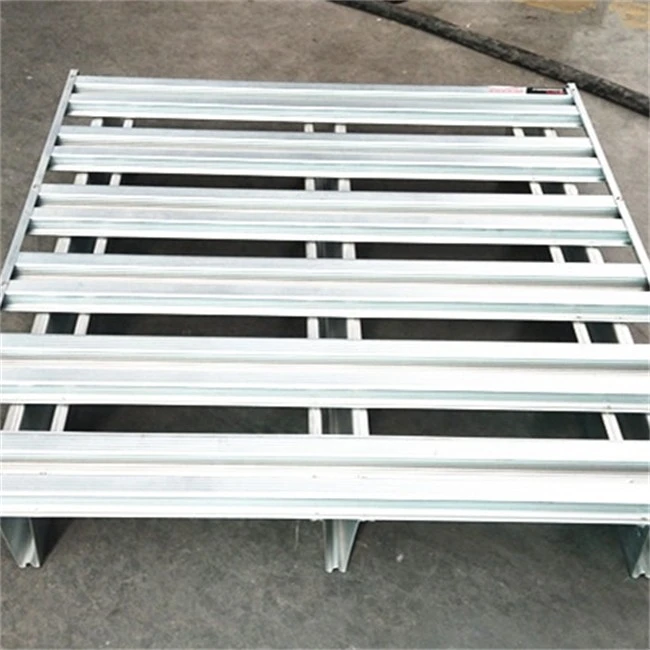
Stainless Steel Pallet
Stainless steel pallets are a high - end option known for their corrosion resistance and durability. Although they are made of stainless steel rather than traditional galvanized steel, the concept of Poisson's ratio still applies. Stainless steel also has a Poisson's ratio in the range of 0.27 - 0.30, similar to carbon steel. This means that the same principles of stress and strain distribution due to Poisson's effect apply to stainless steel pallets as well.
Four Way Fork Full Paving Metal Pallet
Four - way fork full - paving metal pallets are designed to be accessed from all four sides by forklifts. The design of these pallets often involves complex load - transfer mechanisms. The Poisson's ratio affects how the load is distributed across the full - paving surface and the support beams. Engineers need to consider the lateral deformation caused by Poisson's effect to ensure that the pallet can withstand the forces exerted during four - way forklift handling.
Two Way Fork Metal Pallet
Two - way fork metal pallets are simpler in design compared to four - way fork pallets. However, the Poisson's ratio still influences their performance. When a two - way fork pallet is loaded, the lateral deformation due to Poisson's effect can affect the stability of the pallet on the ground and the contact forces between the pallet and the forklift forks.
Conclusion and Call to Action
In conclusion, the Poisson's ratio of galvanized steel pallets, typically in the range of 0.28 - 0.30, is an important factor in their design, performance, and durability. Understanding this ratio helps engineers create safer and more efficient pallet designs, and it also allows users to make informed decisions about the proper use and handling of galvanized steel pallets.
If you are in the market for high - quality galvanized steel pallets, we are here to help. Our team of experts can provide you with detailed information about our products and how the Poisson's ratio affects their performance. Whether you need Stainless Steel Pallet, Four Way Fork Full Paving Metal Pallet, or Two Way Fork Metal Pallet, we have the right solution for your needs. Contact us today to discuss your requirements and start a procurement negotiation.
References
- Budynas, R. G., & Nisbett, J. K. (2011). Shigley's Mechanical Engineering Design. McGraw - Hill.
- Timoshenko, S. P., & Goodier, J. N. (1970). Theory of Elasticity. McGraw - Hill.


